
A plain answer
Limiting beliefs: the ones that sound like good reasons
What limiting beliefs are and how to spot yours. Many hide inside good reasons. Here is a simple way to test one against what is true today.
About 4 minutes to read
A coach you talk to out loud

A limiting belief is a quiet rule that keeps you small. It sounds like a fact, so you rarely stop to question it. Many of these rules made sense once. Some of them are simply out of date now.
The obvious ones are easy to spot, like “I'm not good enough.” The harder ones sound wise and grown-up. They hide inside a good reason, so they never feel like a belief at all.
Limiting beliefs that sound like good reasons
Here are some that capable people carry, in the words they use. Each one holds a grain of truth, and that is exactly why it lasts so long.
- “I'll ask when the timing is right.” Waiting feels sensible, and it also means nobody can say no.
- “If I say no, they will stop counting on me.” Being needed feels safe, so every yes adds to the load.
- “Wanting more is greedy.” It keeps you grateful and quiet, and it keeps you from asking.
- “I should be past this by now.” It turns a normal struggle into proof that you are behind.
- “It's too late for someone like me.” It sounds like realism, but it is really a guess about the future.
- “I need to learn more first.” Learning feels like progress, so the doing keeps moving to next month.
- “People like me don't lead.” It sounds like modesty, and it keeps you out of the room where choices get made.
How to spot your own
- Listen for always and never, as in “I always mess this up.”
- Notice where you stop before you even start.
- Watch for “I can't” in places where “I haven't yet” would be more accurate.
- Notice the reason you give most often. A reason you repeat for months may be a belief in disguise.
- Ask who first said it. Often it was not you.
Five ways to test a limiting belief
Step 1 of 5
Write it down in plain words
Put the belief on paper, exactly as it sounds in your head. Seen on a page, it often looks smaller than it felt.
Step 2 of 5
Look for the evidence, both ways
List the times it was true and the times it was not. Be fair to both lists, and count the small times too.
Step 3 of 5
Ask where it came from
Notice whose voice it sounds like and when you first heard it. A rule learned long ago may fit a life you no longer live.
Step 4 of 5
Write a truer rule
Write a new rule that fits all the facts you found. Make it something you can believe today, not a slogan.
Step 5 of 5
Act on the new rule once
Pick one small action the new rule allows. Do it this week, and notice what actually happens.

Why knowing the belief is not enough
Many people can name their limiting beliefs in detail, and the belief still runs the show. That is because naming it happens in your head, while changing it happens in your week. Each small action adds new evidence to your list. Over time, the old rule has less and less to stand on.
Questions people ask
What are limiting beliefs?
They are quiet rules about what you can do, what you deserve or what you are allowed to want. They feel like facts, so they rarely get tested.
Where do limiting beliefs come from?
They can come from things we heard, saw or lived through. Some were lessons that helped once and never got updated.
Can I get rid of a limiting belief for good?
You can weaken it until it no longer runs the show. Each time you act on a truer rule, the old one gets quieter.
When you want help working through one

Inside the app
What AI Quantum Growth Coach does with a belief like this
Neil is an example member, and he is made up. For a year he waited for the right time to ask for the top job. Under the waiting sat a belief: “I'm good at keeping things running, but I'm not the one people follow.”
AI Quantum Growth Coach is a coach you talk to out loud, and typing works too. In Coach mode it asks questions first, so the answer comes from you.
When Neil blamed the timing, it asked what he would have said if the timing had been good. Then it asked what a no would really mean to him. That is where the belief came into view.
It keeps every conversation, so it can notice when the same belief comes back in a new form. When you want a straight answer instead, you can switch to Consultant mode.
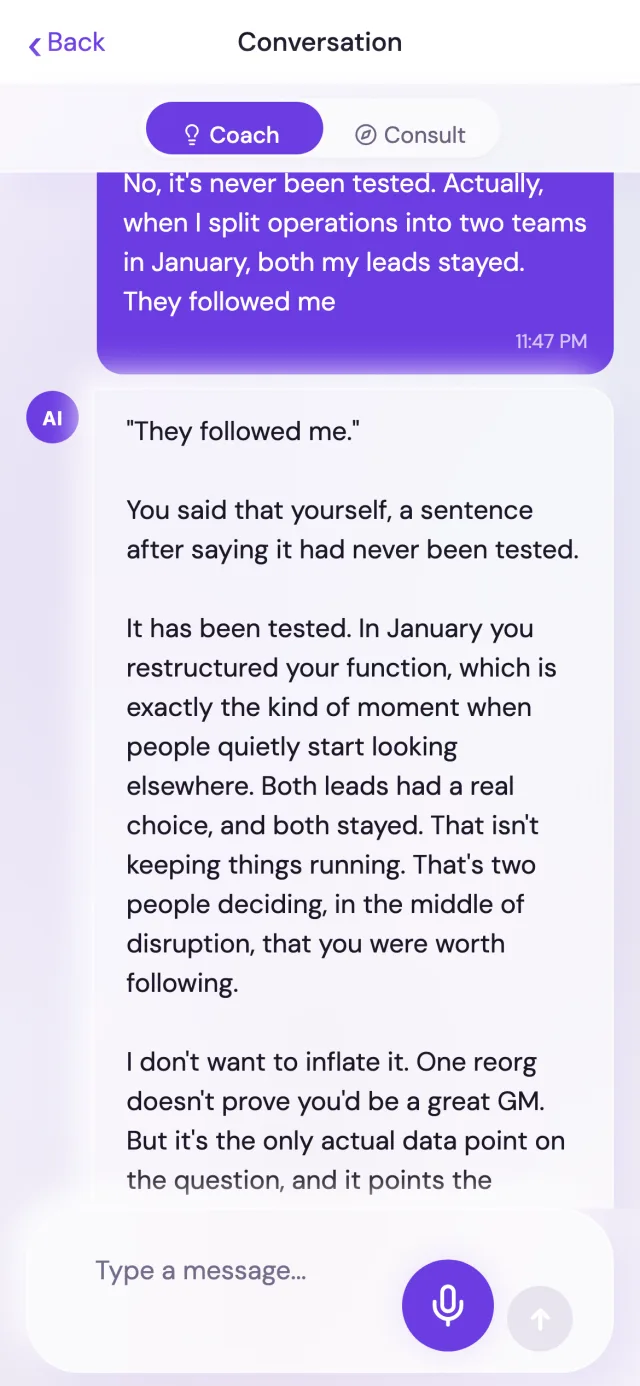
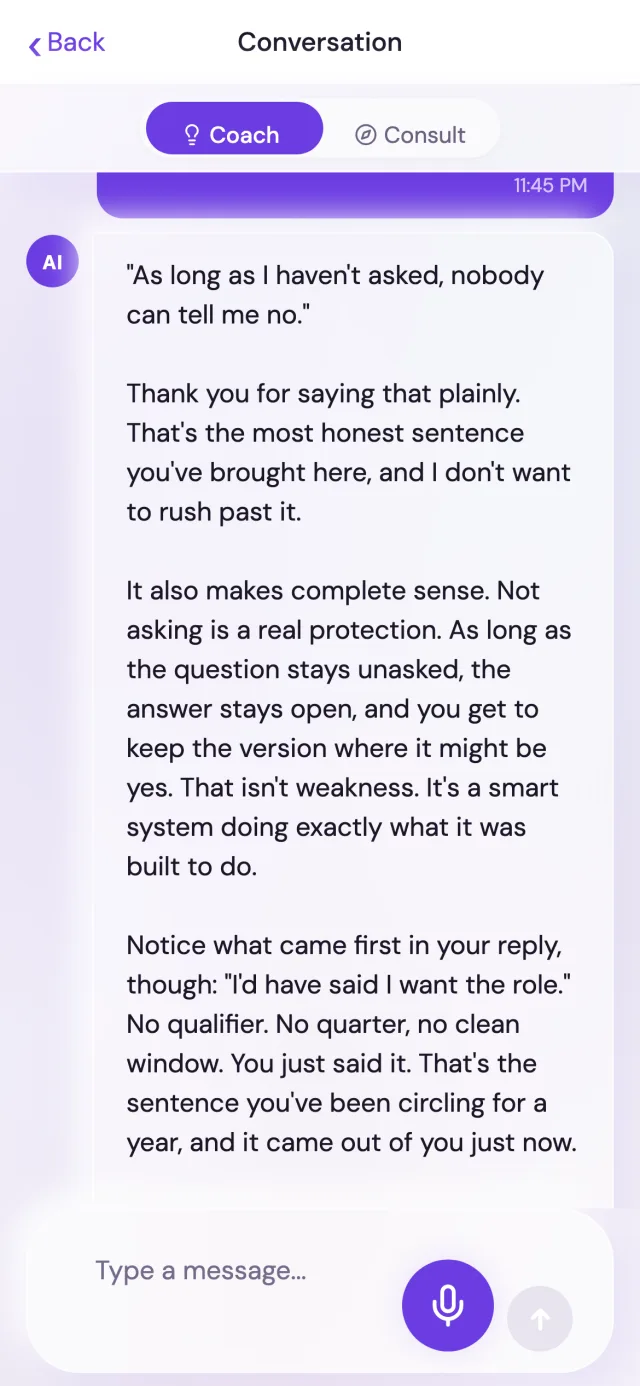
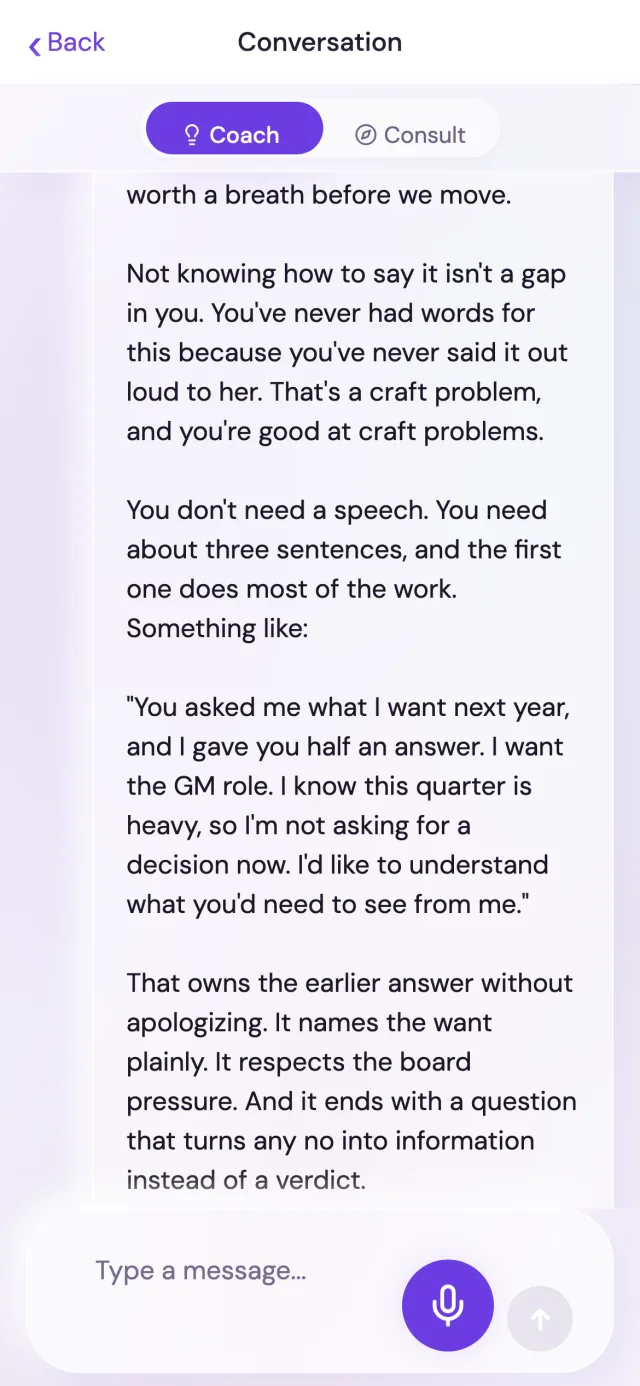
- It hears the proof he skipped past.
- It finds the sentence under the reason.
- It makes the next step small.
Real screens from the live app. Neil, the member in them, is made up.
Watch it work
One late night with the coach
A man has waited a year to ask for the top job. Watch what the coach does with that, out loud, at night.
Every word the coach says in this film is the app's own reply. Neil and his year of sessions are made up.
The real app
The same night, on his phone
He starts talking. 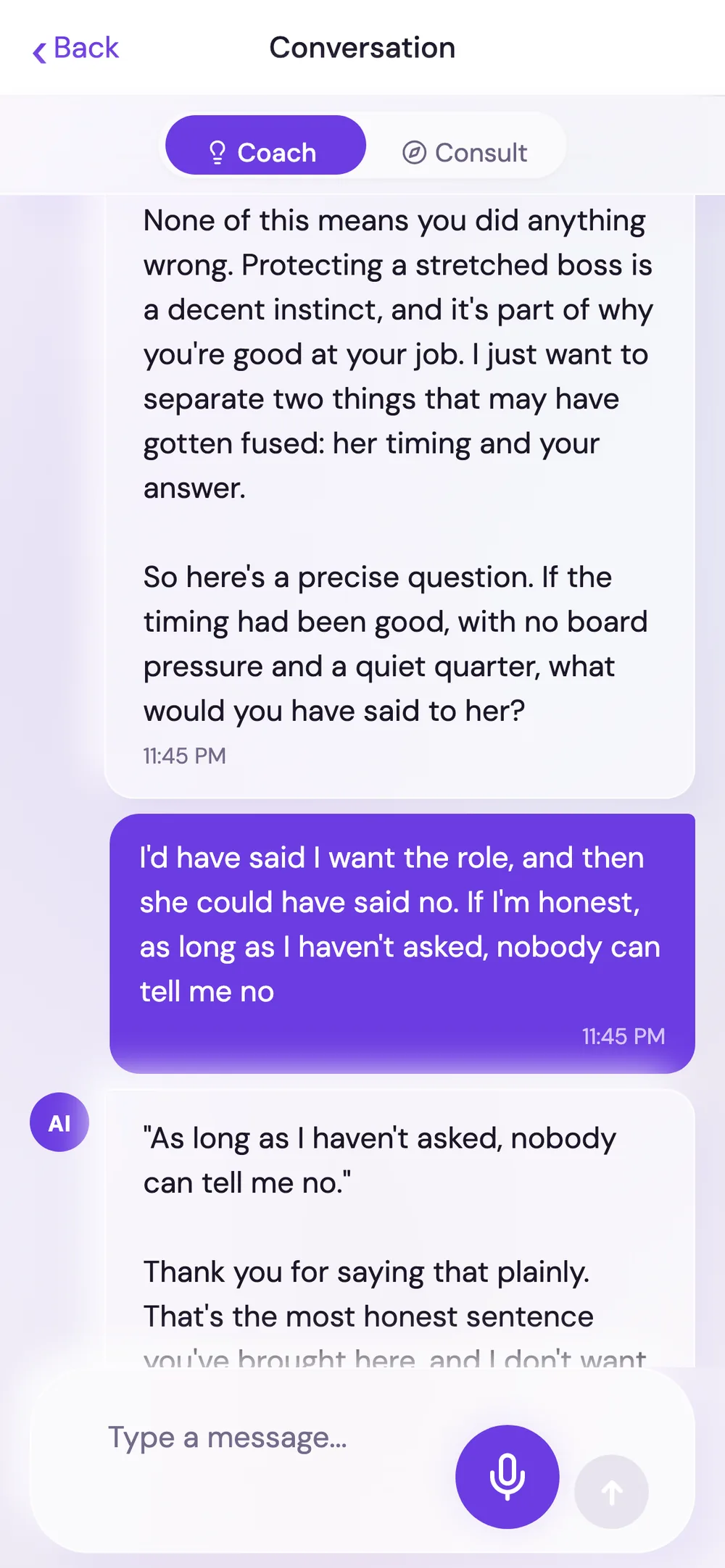
It asks the question under the question. 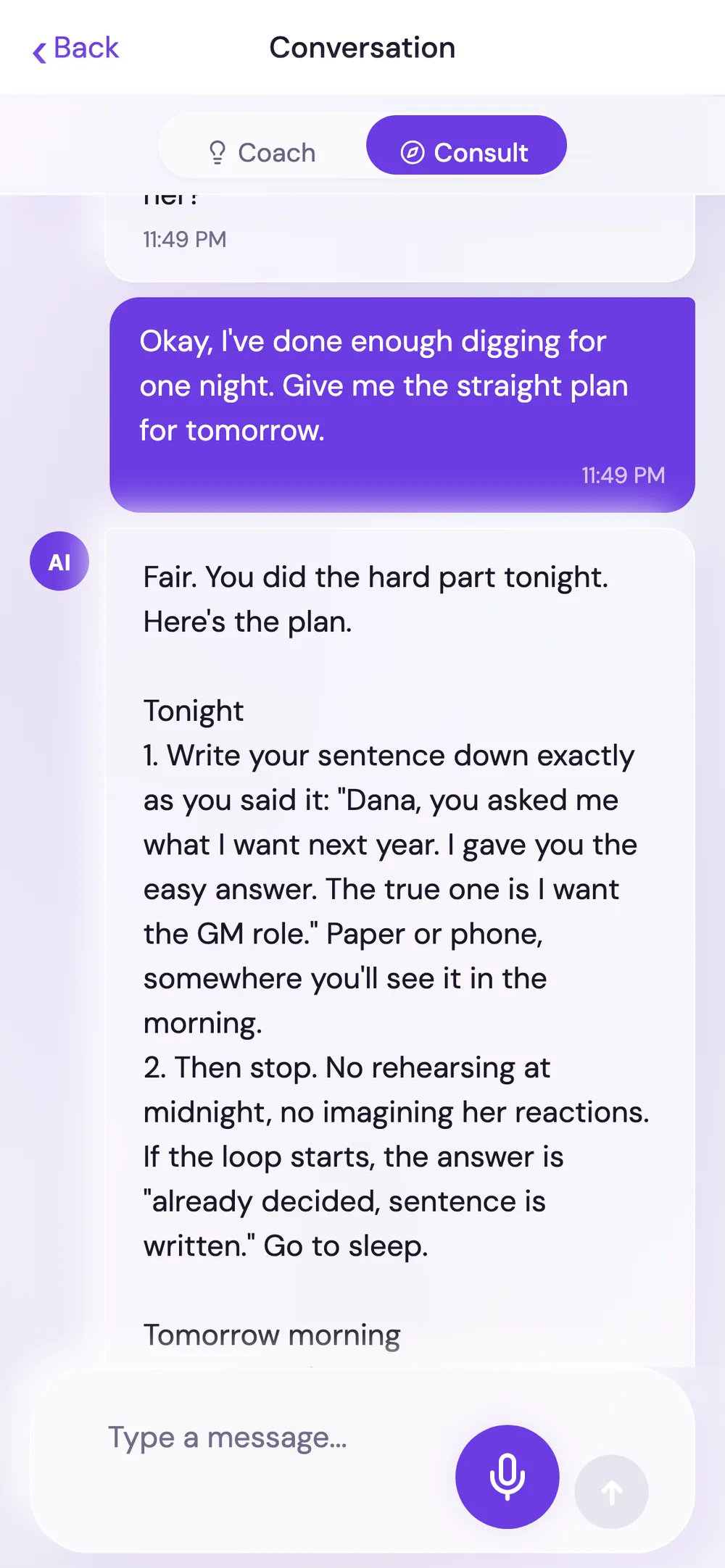
He taps Consult for a straight plan. 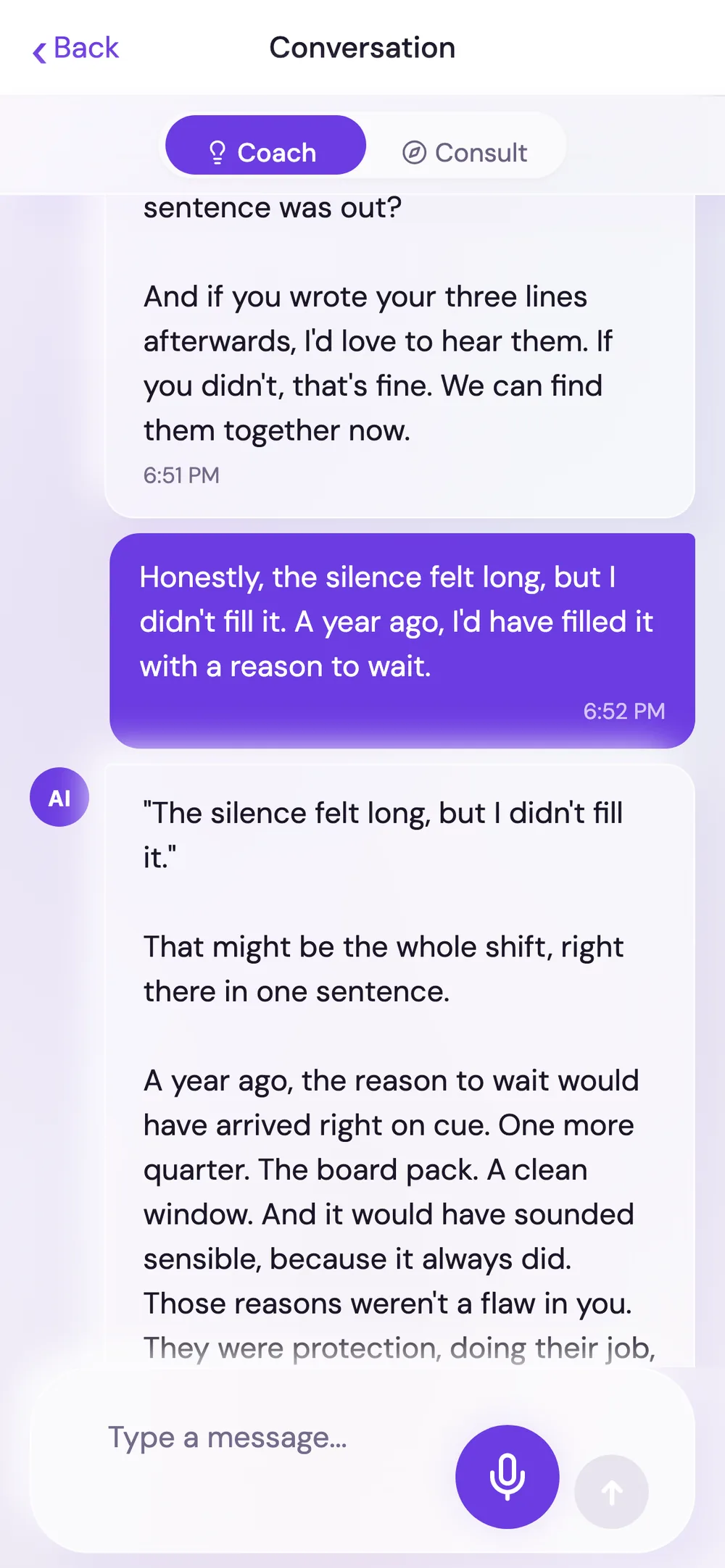
Two days later, it picks up where he left off.
The price
Pick the plan that fits
Yearly
3 days free
then $799 a year
$2.19 a day
$66.58 a month, paid yearly
Pick this if you plan to stay a while. It’s the only plan with the free trial.
Monthly
$84.99
per month
$2.79 a day
21% less than paying weekly
Pick this if you’d rather pay month by month.
Weekly
$24.99
per week
$3.57 a day
Pick this to go a week at a time: $24.99 a week until you cancel.
The 3-day free trial comes with the yearly plan. It’s for your first subscription only, and you need a card to start it. Cancel before the 3 days are up and you won’t be charged. During the trial there’s a fair-use limit on how much you can talk to it.
It works in any web browser, on a phone, a tablet or a computer. On Android you can also get the app on Google Play and sign in with the same account. The iPhone app isn’t out yet.
Not ready yet? Start here
See where it shows up
A limiting belief often lives in the gap between what you know and what you do. The free knowing-doing check helps you find that gap. It is private, and you don't need an account.
The free knowing-doing check
Name one thing you know you should do, answer eight short questions, and see where the gap seems widest for you.
Free · About two minutes · No account