
 From the desk of David Cameron Gikandi, author of A Happy Pocket Full of Money and Creative Consultant on The Secret
AI Quantum Growth Coach
The coach who's awake at 2am and remembers what you told it last month.
You already know what to do. The hard part comes late at night, when the doubt shows up and there's nobody to talk it through with. So I built a coach you talk to out loud. It asks the question underneath the question. It remembers every session. And when you'd rather have a straight answer, one tap gives you one.
3-day free trial on the yearly plan. There's no account to set up first, and you can cancel any time. Already a member? Log in.
Built on a real coaching method, and on more than 20 years of my own work.
It’s 11:30 on a Tuesday night, and the thing you’ve been circling all week is back.
Dear friend,
You’ve read the books and done the courses, and maybe you’ve worked with a coach for a while. You could name your own patterns out loud. You know what to do.
So I’ll skip the lecture. I want to talk about one hour. It’s the hour when all that knowing stops helping, and a lot of us know it well.

It’s late, and the house is still. The thing from earlier in the week walks back in, and the mind starts going round it again.
“My mind won’t settle, and I have nowhere to put it.”
The talk you need right now is one you can’t book. That’s nobody’s failing. Most help runs on a calendar, and 11:30 at night isn’t on it.
I know those late hours from the inside. Even now, as evening comes in, my body gets a little stressed. It goes back to being a boy in Kenya, when my father came home in the evening. Just knowing he was coming, my body would start to brace.
In any house, in any country, a car pulling up in a certain way still gives me a slight jolt.
For years there was something else, too: the same old replay in my head. Round and round it went. It took my attention, and it ate my time. I can’t count what else I might have made with all those hours.
Then something helped. I started saying it out loud. I talked my whole story into the voice memos on my phone. And each day, the replay in my head got a little quieter.

At first, it felt like telling a horror story. By the fourth or fifth time through, it felt like a boring horror story. So many things had cleared. Some of it is still there, and I won’t pretend otherwise. It keeps getting smaller.
Saying it out loud helped me. But a voice memo can’t ask you anything back. And it can’t remember what you told it last month.
The coach I built can do both. You talk to it out loud, the way I talked into my phone. It asks you a good question back, and it remembers what you said.
You still do the work, and it’s coaching, never therapy. But the thing that comes back at 11:30 finally has somewhere to go.
Stay with me for a few minutes, and I’ll take you through it in order. First I’ll show you where the usual help runs out. Then you’ll see what does help at that hour, and what I built. After that comes how you use it, who should leave it alone, and what it costs.
And at the very end, I’ll tell you how the coach began. That was a late night, too.
Where the usual help runs out
Let’s start with what you’ve likely tried already. Each one is good at something. Each row below shows what it does well, and where it stops.
A human coach
What it does well
Depth, care and a real bond with someone who knows you.
Where it stops
$200 to $500 an hour, and often just once a week. At 2am they’re asleep. For the other 167 hours of the week, you’re on your own.
A general AI assistant
What it does well
It’s fast, clever and always awake.
Where it stops
It’s built to answer, where a coach is built to ask. And it wasn’t made to hold your story from one month to the next.
Books and courses
What it does well
The ideas are usually right there.
Where it stops
They gave you the knowledge. But they can’t be in the room at 11:30 when the doubt shows up. That’s where the gap between knowing and doing lives.
Mindfulness and journalling apps
What it does well
Real practice, with real benefit.
Where it stops
They give you room to notice. But nothing talks back, and nothing points out the pattern you’ve repeated for six months.
Therapy
What it does well
The right help for healing, and for anything clinical.
Where it stops
It does a different job. A therapist helps you heal, and a coach helps you grow. This coach is no substitute for therapy.
Keep your coach, and keep your therapist. I built this for 11:30 on a Tuesday, when the doubt is loudest. And I built it to remember what you said the last fifty times.
What helps at that hour is a good question
So what does help at 11:30? Most people picture an AI that hands out advice. A coach works the other way round. It shines a light on what you already know. And you hold more of your own answers than anyone has given you credit for.
Here's the same question put to each one. Read the advice bot first, then the coach.
An advice bot
You: How do I get motivated to exercise?
It: “Here are 10 tips for exercise motivation: 1. Set clear goals…”
A coach
You: How do I get motivated to exercise?
Coach: “Before we look for answers, what does exercise mean to you? Is it health, how you look, energy, or something under that?”
You: I guess I want more energy to play with my kids.
Coach: “Then that’s the real goal. Picture yourself with that energy, playing with them. What does that version of you look like?”
Two questions in, the second conversation was about the kids.
Here's the whole difference in short, side by side.
| An advice bot | A coach |
|---|---|
| Answers your question | Helps you find your own answer |
| Gives you facts | Helps you see something new |
| Does the solving for you | Leaves you able to solve it yourself |
| You ask, it answers | It asks, you think |
What I built: a coach you talk to out loud
That kind of question is what I wanted at 11:30, so I built a coach that asks it. It’s called the AI Quantum Growth Coach. You talk to it out loud, and unlike my voice memos, it talks back. Under the warmth sits a real coaching method called LEAD. Each letter is one thing it does, in this order.
- L
Listen
It hears what you said and gives your own words back to you first. Every reply has a question in it, one at a time, so the talk keeps coming back to you.
- E
Empower
It treats you as whole and able, the expert on your own life. It might ask, “You’ve come through hard things before. What got you through then?”
- A
Ask
It asks more than it tells. Some questions open things up, and some sharpen them. Some push gently on a belief you’ve never checked. Others ask what matters most to you.
- D
Deliver, sparingly
A technique comes out only when you’re stuck and ready for one, and it asks you first. Plenty of good sessions end without one at all.
When you’re ready for a technique, it can draw on more than 320 of them. Here are five you may have heard of:
- The 5 Whys
- Scaling Questions
- The Miracle Question
- Reframing
- Direct Communication
The library comes from more than 20 years of my work. That includes 889 files of notes and transcripts from my courses and books.
What asking looks like, five questions deep
Take the first of those five, The 5 Whys. It keeps asking instead of stopping at the first answer, and it can go like this:
You: I can’t seem to stick to my morning routine.
Coach: Why is that?
You: I keep hitting snooze.
Coach: Why do you hit snooze?
You: I’m too tired in the morning.
Coach: Why are you so tired?
You: I stay up scrolling.
Coach: And what does the scrolling give you?
You: It’s the only time that’s mine.
By the fifth answer, nobody's talking about alarm clocks any more.
What makes it different: it remembers you
Asking is half of what makes it work. The other half is memory. Plenty of AI tools meet you fresh each time, so you explain yourself again and again. This coach keeps your whole history, so session 50 sounds nothing like session 1. That memory is the part I cared about most when I built it.
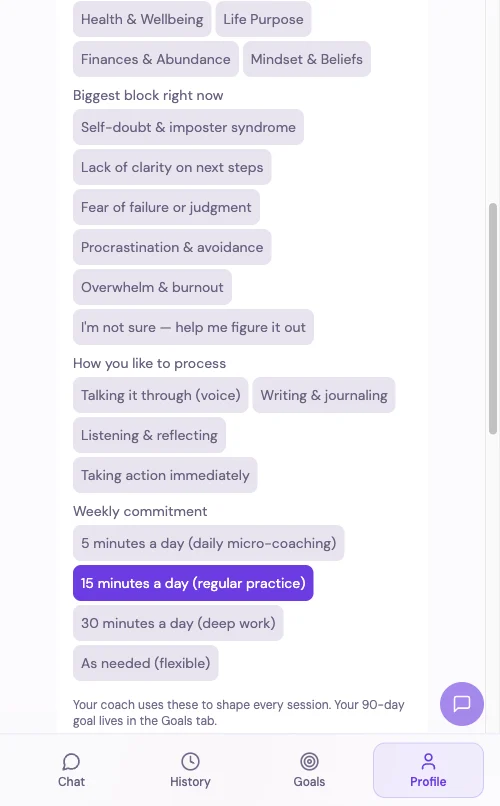
It keeps your goals, your patterns and the promises you made yourself. The next session starts from there.
Session 50 picks up exactly where session 49 left off.
You talk, and it talks back
Hear the voice you'd be talking to.
You'll mostly hear all of this, rather than read it. You talk the way you would on a walk with a friend, and the coach answers out loud. Here are three short samples in the coach's own voice. I scripted them, so you can judge how it sounds without taking my word for it. Press play on any of them.
A question that makes you stop. It asks about your body this time, instead of your calendar.
It picks up something you said weeks ago, without being asked.
The same coach in Consultant mode, being direct because you asked it to be. You’ll meet that mode in the steps just below.
How it works, in four steps
So that’s what it is. Here’s how you use it, in four steps that you take in order. Most of it is you, talking.
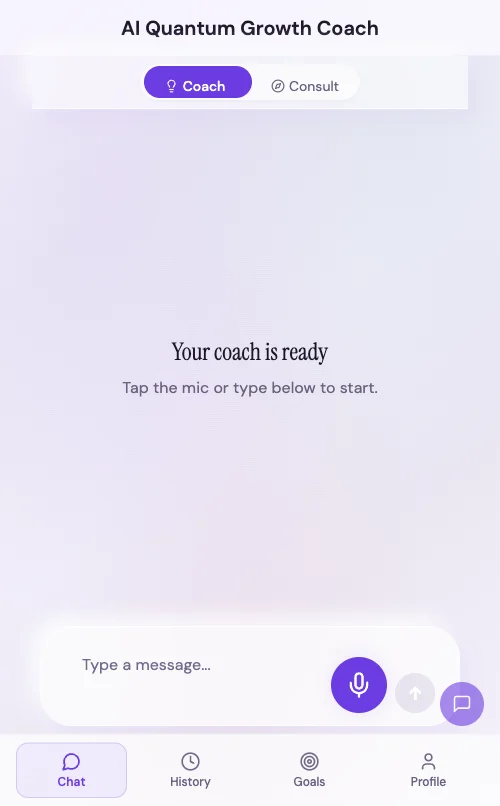 Step 1 of 4
Start talking
Tap the mic and say what’s on your mind, the way you would to a friend. There’s no clever prompt to write. If you’d rather type, that works too.
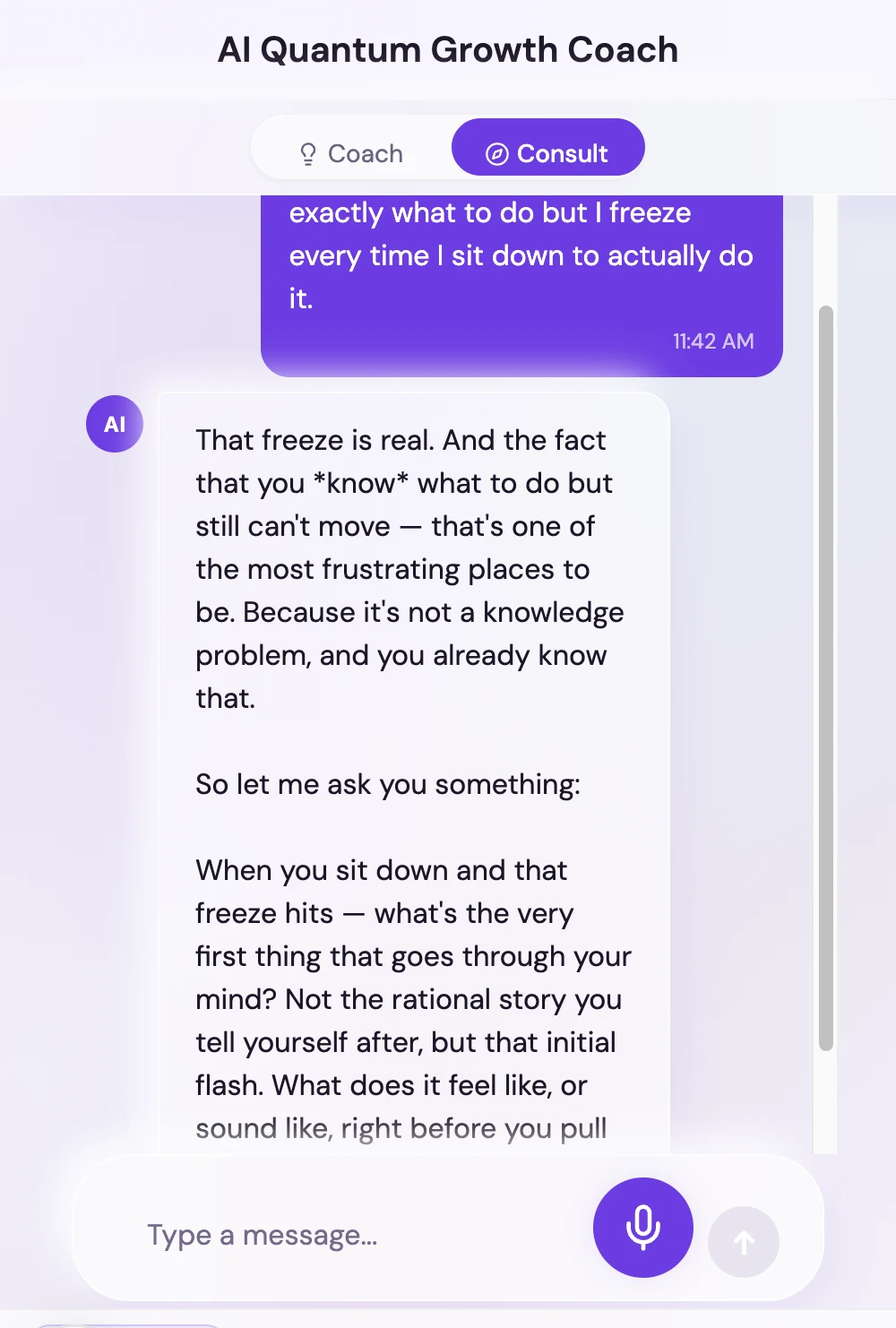 Step 2 of 4
Pick how it talks to you
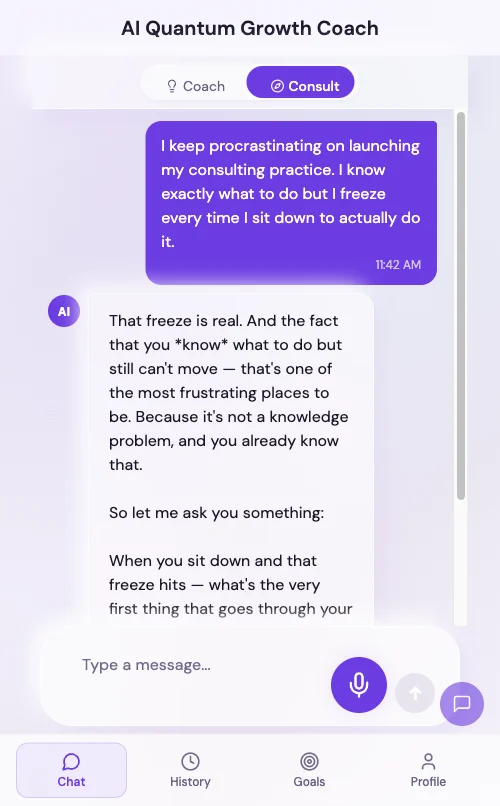
The coach has two modes, and you pick the one that fits tonight. At the top of the chat there are two buttons, Coach and Consult. You can switch with one tap at any time, even halfway through a session.
Pick one. You can switch any time.
Coach mode
The default · tap Coach
Pick this if you want to think out loud until you find your footing. It listens and asks, and it won’t hand you a plan you didn’t reach yourself.
“What would have to be true for that to feel doable?”
or
Consultant mode
One tap away · tap Consult
Pick this if you’d rather skip the questions and get the answer. It gives you 2 or 3 clear options and your next steps. It draws on proven ideas from business and psychology.
“Here are three options, and here’s the one I’d start with.”
Switching resets nothing. It's the same coach with the same memory.
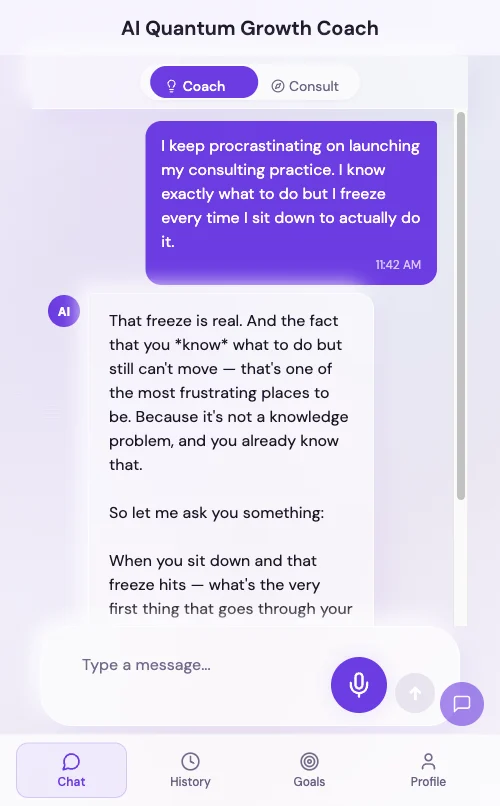 Step 3 of 4
Keep talking
In Coach mode it asks, and you answer in your own words. It works the LEAD way you read about above: it listens, then asks the next question. In Consultant mode it’s the other way round. You ask, and it answers.
 Step 4 of 4
Come back any time
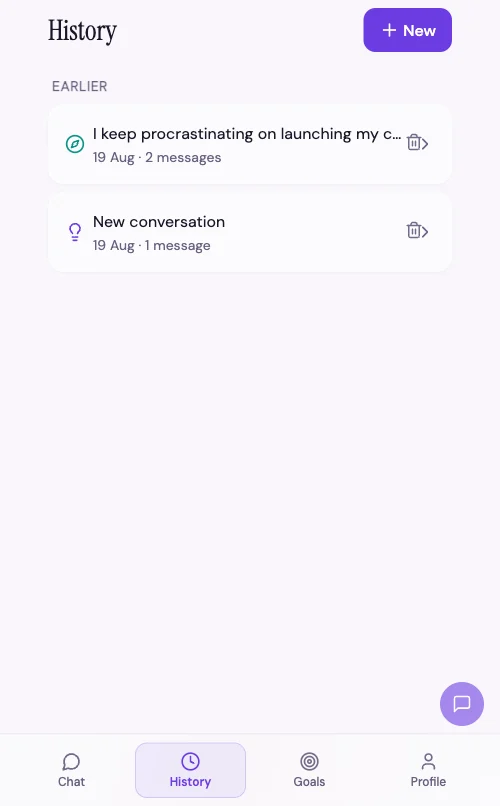
Tomorrow or next month, it picks up where you left off. That’s the memory you read about above, so you never have to start over.
What one session sounds like, with my notes
Put those four steps together, and a session goes something like this. I wrote this one to show the method at work, so it’s made up. It isn’t from anyone’s real session. My notes beside it say what the coach just did, and why.
Illustrative: I wrote this session to show the method.
Want to try it on the thing you’ve been circling?
Your first session starts with one sentence, said out loud.
Start the 3-day free trial →3-day free trial on the yearly plan, then $799 a year. Cancel any time. Already a member? Log in.
What a day with it looks like
That was one session. Here’s how the coach fits into a whole day. Picture an ordinary day, and four moments in it. The last one is 11:30 at night, where this letter began.
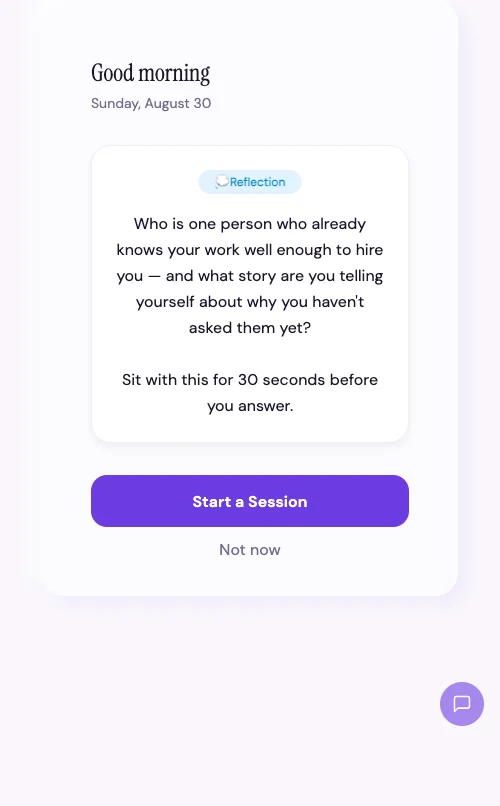
6:00am
One line to start the day
A question, a thought, or a note about something you said last week. It’s waiting for you when you open the app, and it’s written from your own history with the coach.
12:30pm
When you need the answer
There’s a work decision you’ve been circling. You switch to Consultant mode and get 2 or 3 clear options, with your next steps. Then you get on with your day.
6:15pm
The phone stays face down
Dinner, and nothing to check. Whatever you needed to think about is held somewhere, waiting for you.

11:30pm
The one that matters
Remember the Tuesday this letter began with? The thing comes back, the way it usually does. This time you say it out loud, and the coach already knows the shape of it.

What happens to what you tell it
By now you can see you’d be telling it a lot: your nights, your work, your family. A coach that remembers all that owes you a straight answer about where it keeps it. Here are the four things I made sure of. Each one is built into the code, and the tag on each row names the part that does it.
row_level_security: ON · double-enforcedYour sessions are locked to your login, twice.
Each session is stored in rows tied to your account, and row-level security guards those rows. Then every server function checks again that the session is yours. Only then does it read a word.
voice_input: transcribed → discardedYour voice recordings are never stored.
What you say is turned into text for the coach to work with. Then the audio is let go. No copy of your voice is kept anywhere.
shared_index: your sessions NOT embeddedYour words never go into a shared AI index.
The library the coach searches is built from my course material and techniques. Your sessions are never added to it. Its memory of you lives only in your own rows.
payments → stripe.com · delete: CASCADEWe never see your card, and you hold the delete key.
Payments run through Stripe’s own checkout page. Stripe is certified PCI DSS Level 1, so your card details never reach us. Deleting your account cancels your billing. It also wipes your sessions, memory and goals, in one step.
There's one more thing you should know. To answer you, the coach sends your words to the services it runs on: Anthropic's Claude for the replies, and ElevenLabs for the voice. The privacy policy lists every service involved.
Everything in transit is encrypted. And your sessions are never sold or used to train AI models.
I chose boring, proven security. That's what I want under your most honest sessions.
Will it work for someone like me?
So now you know what it does, and where it keeps what you say. That leaves the fair question to ask before you pay. It suits some people very well, and for others it’s the wrong tool. I’d rather say so now. Read both lists and see which one sounds like you.
It’s for you if
- You already know what to do. The hard part is doing it, at the hour the doubt shows up.
- You can name your patterns out loud. You’ve just never had a place to put them that remembers.
- You’d rather be asked a good question than be handed one more framework.
- You’ve done some of the work already: the books, the courses, maybe therapy. This builds on it.
Leave it alone if
- You’re in crisis or acute distress. You deserve a person, today. Please contact your local emergency services or a crisis line.
- You want someone to make your decisions for you. Even in Consultant mode, the choice stays yours.
- You want a free AI tool or a casual chat. There’s no free plan, and it isn’t built for small talk.
- You need clinical treatment. This is coaching, and it stays firmly on that side of the line.
If the first list sounds like you, the honest way to find out is the 3-day free trial. Talk to it about what’s really on your mind. By the end of the third day, you’ll know. Here’s what it costs.
What it costs, and why
There are three plans, and every one gets the whole coach: the memory, the LEAD method and both modes. There’s no account to set up first. Pick one of the three plans below, pay, and you’re in.
Yearly
$799
per year
$2.19 a day
3-day free trial · $66.58 a month
Pick this if you plan to stay a while. It’s the only plan with the free trial.
Monthly
$84.99
per month
$2.79 a day
21% less than paying weekly
Pick this if you’d rather pay month by month.
Weekly
$24.99
per week
$3.57 a day
Pick this if you want to start small, one week at a time.
The 3-day free trial comes with the yearly plan. It’s for your first subscription only, and you need a card to start it. Cancel before the 3 days are up and you won’t be charged. During the trial there’s a fair-use limit on how much you can talk to it.
It works in your web browser, on a phone, tablet or computer. The iOS and Android apps aren't out yet.
On the yearly plan it works out at $66.58 a month, or $2.19 a day. One hour with a good human coach costs more than a whole month of this. And this one is there at 2am.
So why does the free trial come only with the yearly plan? Three free days cost me real money in AI time. I’d rather spend that on people who plan to stay a while, and that’s also where the memory pays off.
Your questions, answered straight
That’s the whole offer. Here are the questions I’d ask in your place, the awkward ones too. I’ve answered them the way I would if you emailed me. Tap a question to open it.
How is this different from a general AI assistant?
In two ways, and you’ve seen both above. It asks before it answers, using the LEAD method. And it remembers every session, so each one starts where the last one ended.
Is AI coaching as good as a human coach?
It’s different, as the table near the top shows. A good human coach brings care and presence, and I won’t pretend this replaces that. What this adds is a memory of every session, at any hour. So it can spot patterns across months, where a person sees one hour at a time.
Is this therapy?
No, and it matters that it isn’t. As the table near the top says, therapy helps you heal and coaching helps you grow. If you’re in crisis, please contact your local emergency services or a crisis line. In the US, that’s 988. The app also has safety steps. If it picks up signs of distress, it points you toward proper help.
Is my data private?
Yes. The privacy part above sets it out in full. In short, your sessions are locked to your account, never sold and never used to train AI. Your voice recordings are never kept.
Which devices does it work on?
Your web browser, on a phone, a tablet or a computer, as the price part says. The iOS and Android apps aren’t out yet. I’d rather tell you that than show you store badges that go nowhere.
Do I need an account before I can buy?
No. Pick a plan, enter your email and pay. Your account is made right after, and we email you a link to get in. You can set a password later, or ask for a sign-in link each time.
How do I cancel?
In the app, go to Profile, then Manage Subscription. That opens the billing portal. There’s no maze and no phone call. If it’s the wrong fit for you, I’d rather you went and found the right one.
Is there a free version?
No. The yearly plan starts with the 3-day free trial instead, as the price part above says. Coaching asks something of both sides, and a free version mostly draws casual use. The trial lets you feel it working before you pay.
Why does it cost more than most apps?
Because the fair thing to compare it with is a human coach, at the $200 to $500 an hour you saw near the top. At $66.58 a month on the yearly plan, this costs 67 to 87 percent less than one hour a month with one.
Something I haven't answered? Email me.
One last thing
Why I built it
You've seen what it does and what it costs. The last thing I owe you is why I built it at all. It started with a conversation at 11pm on a Tuesday.
I was talking to an AI late one night. It was about my father, and about a pattern I'd noticed in myself. Instead of advice, it asked me something I wasn't expecting:
“What do you think would happen if you actually got what you wanted?”
I sat with that for a long time.
The next week I came back, and it remembered. It had my words, and it had the thread under them too. It picked up exactly where we'd left off.
Nobody had done that for me before. The self-help books hadn't, and neither had the meditation app I gave up on. Even the human coach I saw for six months kept asking me to explain my situation again. She couldn't hold all the threads.
So I set out to build a coach that never forgot.
If that sounds like what’s been missing, start the 3-day free trial on the yearly plan. Talk to it tonight about the thing you’ve been circling. And if it turns out to be the wrong fit, cancel before the trial ends and you won’t be charged.
Warmly,
David Cameron Gikandi
P.S. Saying it out loud helped me, a little more each day. The next time that thing comes back at 11:30, you can say it out loud too. This time, the coach asks you a good question back. And it remembers what you told it last month.
P.P.S. The yearly plan starts with the 3-day free trial. So you can have a few real sessions with it before you pay anything.
All of it, in one place
Here's the whole letter in four lines.
- A coach you talk to out loud, at any hour, for the gap between knowing and doing
- A memory of every session, so session 50 picks up where 49 left off
- The question underneath the question, and a straight answer when you’d rather have one
- $66.58 a month on the yearly plan, with the 3-day free trial first
3-day free trial on the yearly plan, then $799 a year. Cancel any time. Already a member? Log in.