
A plain answer
How to stop self-sabotage when you already know better
Why we stop right before the moment that counts. Why more advice does not fix it. And small steps that help you follow through.
About 5 minutes to read
A coach you talk to out loud

Self-sabotage is when part of you works against what you want. You know what to do, and you still don't do it. Or you start, then stop right before it counts. If that sounds familiar, you are in good company. It is often the people who know the most who feel it the most, because the gap is so easy to see and so hard to close.
It is not a flaw in who you are. It is usually an old way of staying safe, still doing its job long after the danger has passed.
Why more advice has not fixed it
Most advice on self-sabotage is about knowing. Notice your patterns, find the cause, be kind to yourself. That is good advice, and you may know it by heart. But knowing was never the hard part. The stall happens in the doing, in a single moment. That moment needs a different kind of help.
Where it shows up: right before the moment that counts
Self-sabotage rarely shows up on an ordinary day. It shows up at the edge of something that matters. These are the places to look first.
- Right before you ask, whether it is for the role, the raise or the sale.
- Right before you hit send on the thing that would make you more visible.
- Right before you finish, when the last small part turns into one more round of polish.
- Right before you say no, when saying yes to everyone feels safer.
- Late at night, when the same worry plays on repeat and nothing gets decided.

The very good reason
The hardest kind of self-sabotage does not look like self-sabotage at all. It looks like a very good reason. The timing is wrong. You need more information first. Your boss is busy this quarter. Each reason can be true. So here is a simple test. Ask what you would do if the reason went away tonight. If the answer comes fast, the reason may be standing in for a fear.
Neil is a made-up example. For a year he wanted the top job in his division, and each time there was a good reason to wait. When his boss finally asked what he wanted, he said he was happy where he was.
Six steps to stop self-sabotage
Step 1 of 6
Catch the exact moment
Notice the point where you stall. Is it before you send, before you ask, or before you finish? Write it down the same day.
Step 2 of 6
Name the very good reason
Write down the reason you gave yourself. Then ask what you would do if that reason vanished tonight.
Step 3 of 6
Ask what it protects
Ask what you fear would happen if you did the thing. Often the answer is being judged, being seen, or hearing no.
Step 4 of 6
Make the step smaller
Cut the task until it feels almost too easy. Send one email, not ten. Ask for a meeting, not for the decision.
Step 5 of 6
Decide when and where
Pick a time and a place for the small step. A plan for when and where beats a promise to try harder.
Step 6 of 6
Look back without blame
At the end of the day, note what you did. Be kind about what you didn't do. Then set the next small step.
When it shows up late at night
The doubt often arrives at night, when nobody is awake to talk to. Writing it down helps. Saying it out loud can help even more, because a thought you hear is easier to question. Ask yourself the question under the worry, and write down your first answer. Then leave the decision for the morning.
Questions people ask
Is self-sabotage a sign that I don't really want it?
Usually not. It often shows up because the thing matters to you. The bigger the step, the louder the part that wants to keep you safe.
Why do I self-sabotage when things are going well?
Good things can feel risky too. Success brings new eyes, new hopes and new ways to fall short. So a quiet part of you may reach for the brakes.
How long does it take to change the pattern?
It changes one small step at a time. Each time you follow through, the next step gets a little easier.
When you want someone to talk it through with

Inside the app
What AI Quantum Growth Coach does with the same gap
Neil is an example member, and he is made up. He keeps finding a good reason not to ask for the job he wants.
AI Quantum Growth Coach is a coach you talk to out loud, at any hour, in your web browser. Typing works too. In Coach mode it listens, gives you your own words back, and asks questions first.
When Neil says the timing was bad, it asks what he would have said if the timing had been good. The answer comes from him, not from a list of tips.
It keeps every conversation, so the next talk starts where the last one stopped. When you would rather have a straight answer, you can switch to Consultant mode in the middle of a talk.
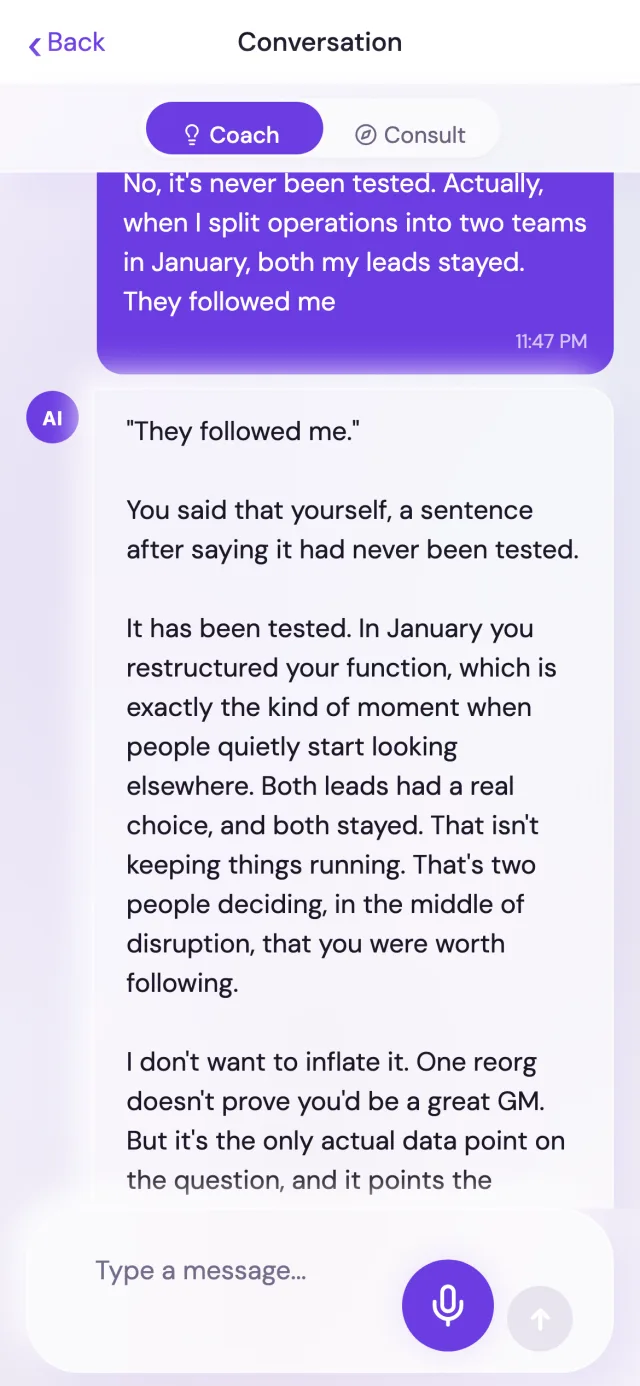
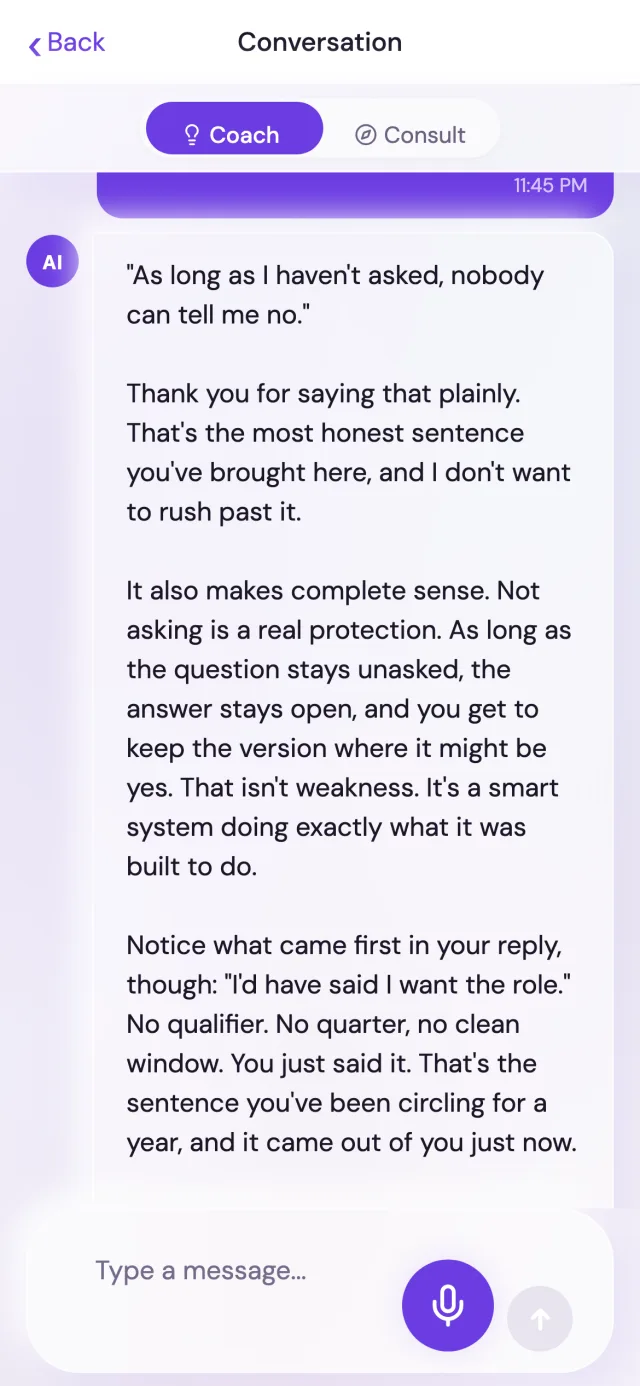
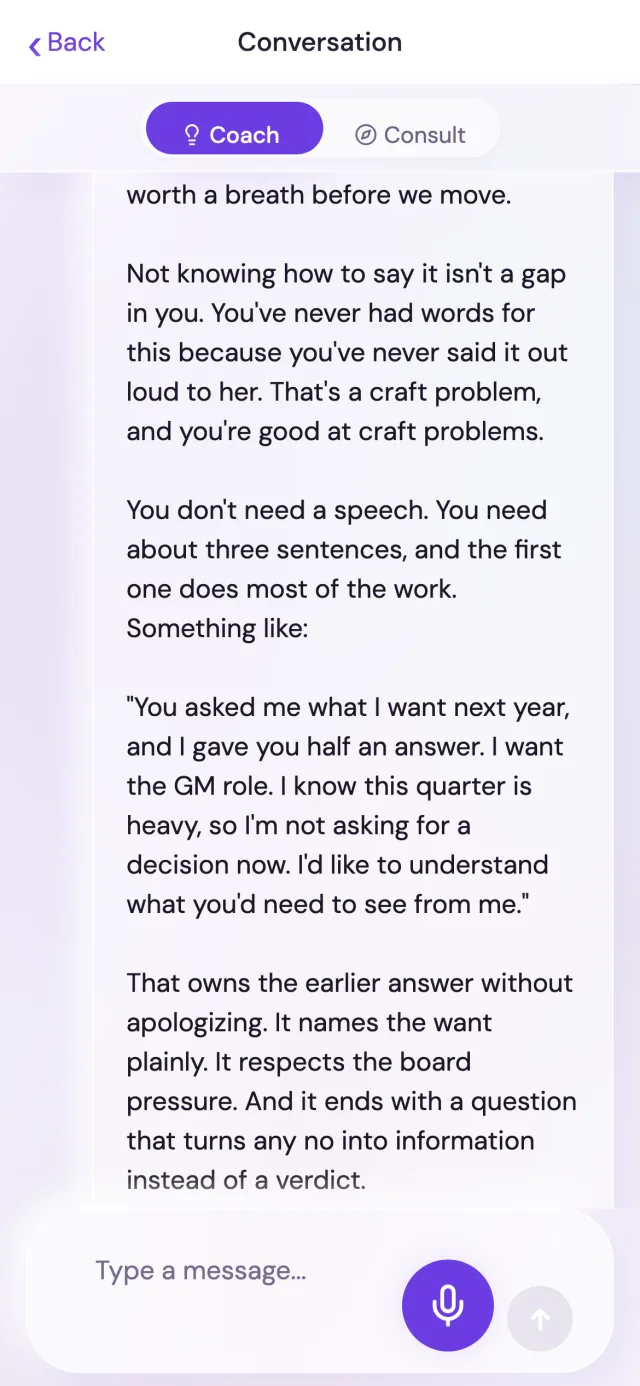
- It hears the proof he skipped past.
- It finds the sentence under the reason.
- It makes the next step small.
Real screens from the live app. Neil, the member in them, is made up.
Watch it work
One late night with the coach
A man has waited a year to ask for the top job. Watch what the coach does with that, out loud, at night.
Every word the coach says in this film is the app's own reply. Neil and his year of sessions are made up.
The real app
The same night, on his phone
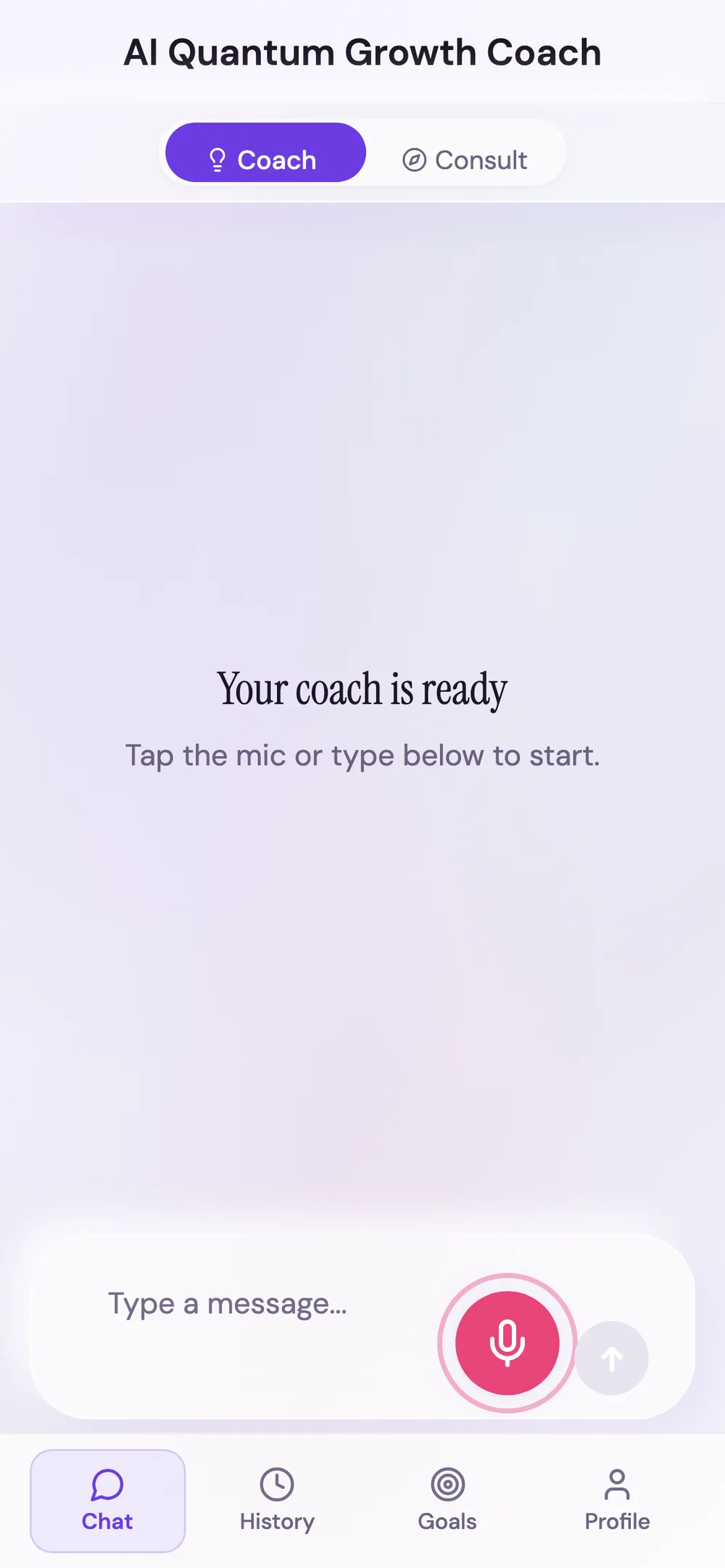
He starts talking. 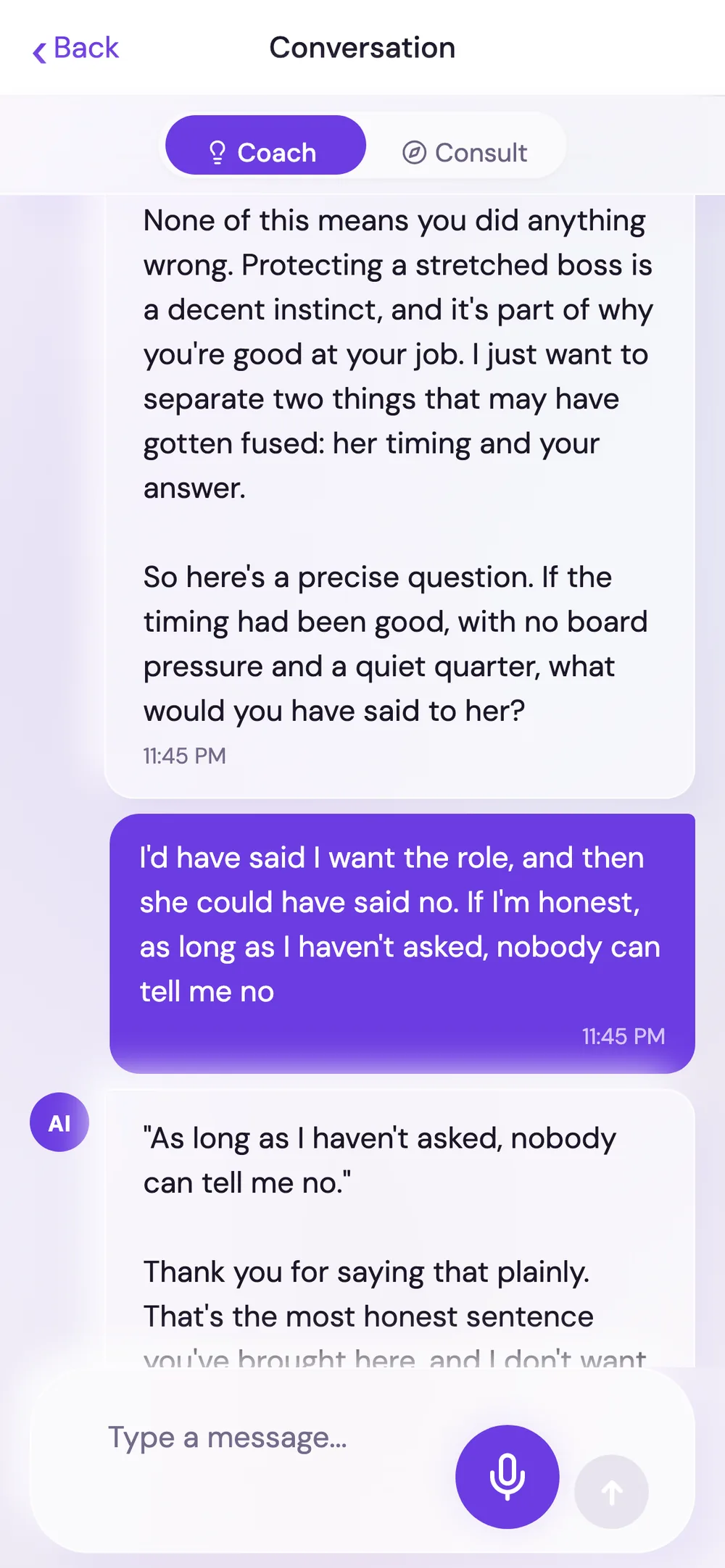
It asks the question under the question. 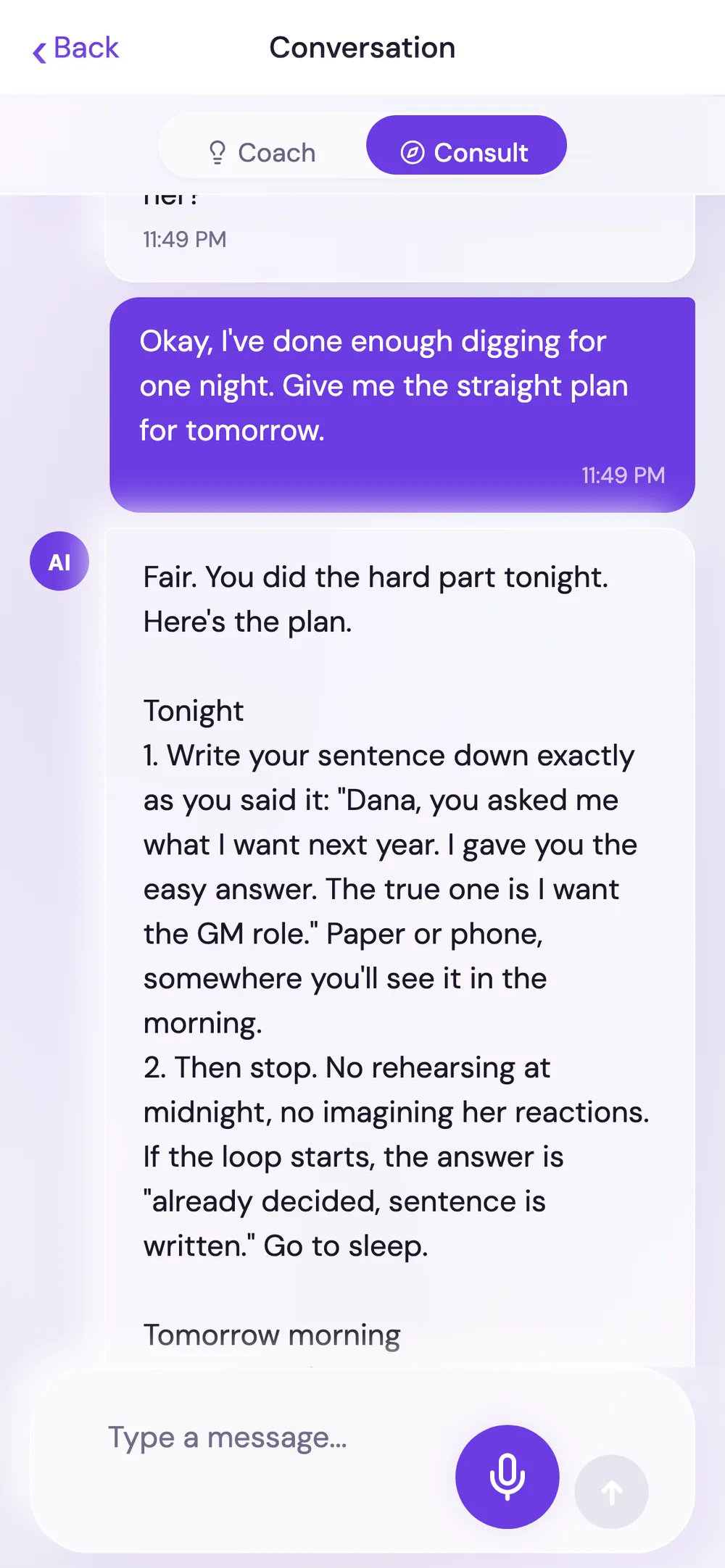
He taps Consult for a straight plan. 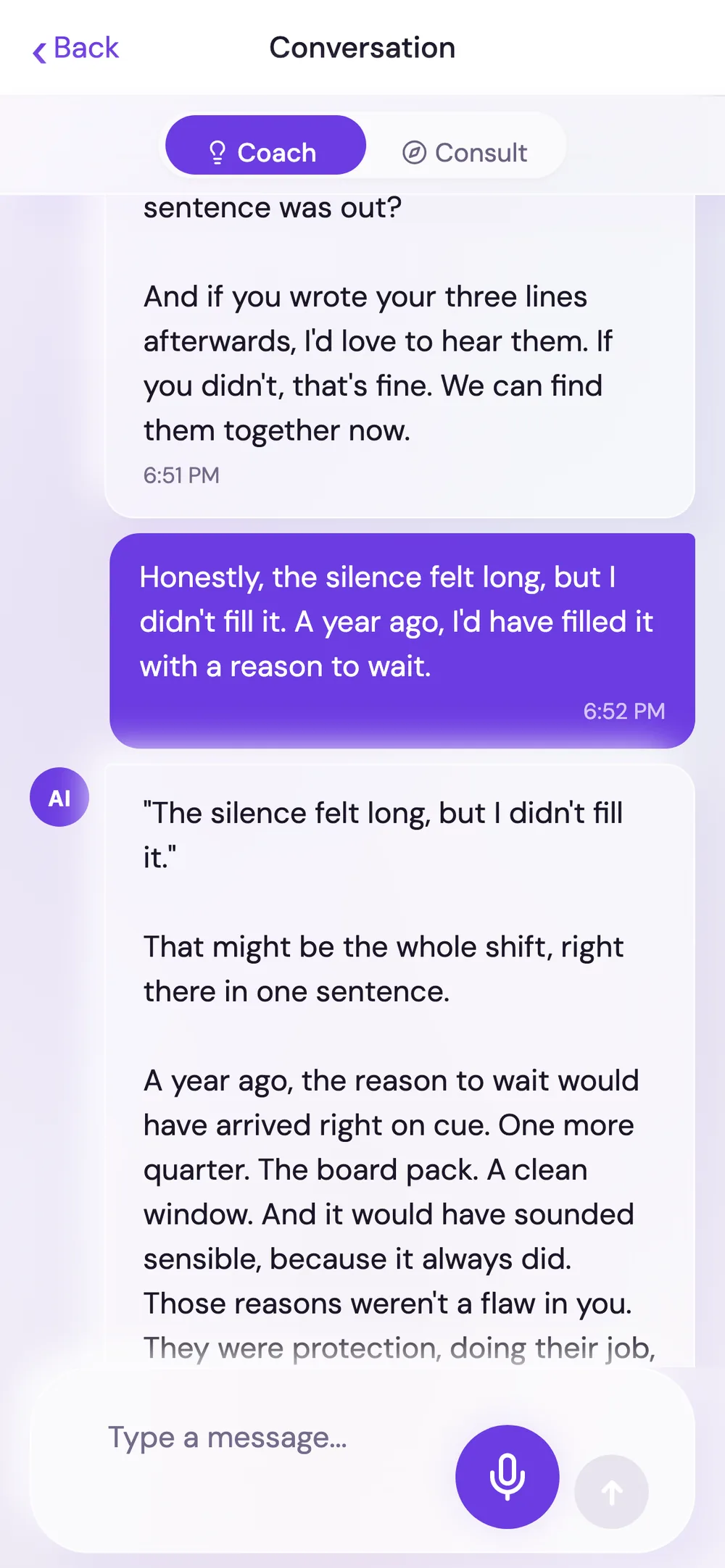
Two days later, it picks up where he left off.
The price
Pick the plan that fits
Yearly
3 days free
then $799 a year
$2.19 a day
$66.58 a month, paid yearly
Pick this if you plan to stay a while. It’s the only plan with the free trial.
Monthly
$84.99
per month
$2.79 a day
21% less than paying weekly
Pick this if you’d rather pay month by month.
Weekly
$24.99
per week
$3.57 a day
Pick this to go a week at a time: $24.99 a week until you cancel.
The 3-day free trial comes with the yearly plan. It’s for your first subscription only, and you need a card to start it. Cancel before the 3 days are up and you won’t be charged. During the trial there’s a fair-use limit on how much you can talk to it.
It works in any web browser, on a phone, a tablet or a computer. On Android you can also get the app on Google Play and sign in with the same account. The iPhone app isn’t out yet.
Not ready yet? Start here
Check your own knowing-doing gap
Self-sabotage lives in the gap between what you know and what you do. The free knowing-doing check shows you where that gap is widest. It is private, and you don't need an account.
The free knowing-doing check
Name one thing you know you should do, answer eight short questions, and see where the gap seems widest for you.
Free · About two minutes · No account